
I’m comparing central AC vs ductless mini splits for my Des Moines home. Which one makes more sense?
When it comes to the central AC vs ductless mini split comparison, the short answer is: neither system is right for every home. The better fit depends on whether you have existing ductwork, how many rooms you need to cool, and what kind of comfort control you want.
Quick Comparison: Central AC vs Ductless Mini Split
| Factor | Central AC | Ductless Mini Split |
|---|---|---|
| Best for | Larger homes with existing ducts | Homes without ducts, additions, zoning |
| Efficiency (SEER2) | Up to 21+ SEER2 | Up to 38+ SEER2 |
| Energy loss | 25-30% lost through ducts | Near zero duct loss |
| Installation disruption | High (if no ducts exist) | Low (3-inch wall penetration) |
| Zoning control | Limited without dampers | Built-in, room by room |
| Heating capability | Cooling only (needs furnace) | Most units heat and cool |
| Noise level | Moderate (air handler + vents) | 19-26 dB (whisper quiet) |
| Ideal home type | New builds, large floor plans | Older homes, additions, problem rooms |
Heating and cooling account for a major share of a typical home’s energy use. That makes this decision an important one for homeowners in Des Moines and across Central Iowa, where summers get hot and winters get brutal.
One common issue is that central air is familiar and discreet, but it depends heavily on ductwork that may be leaking cooled air before it ever reaches your living room. Ductless mini splits are highly efficient by design, but they come with visible wall units and may not be the preferred look for every room.
This guide breaks down the major factors – efficiency, installation, comfort, and maintenance – so you can make a confident, informed decision.
Understanding the Mechanics of Modern Cooling
To settle the debate, we first have to look under the hood. Central air conditioning is a “forced air” system. It uses a single large indoor evaporator coil, usually sitting on top of your furnace, and a powerful blower fan to push chilled air through a network of ducts. It’s a whole-home approach, with one thermostat typically calling for cooling across the house.
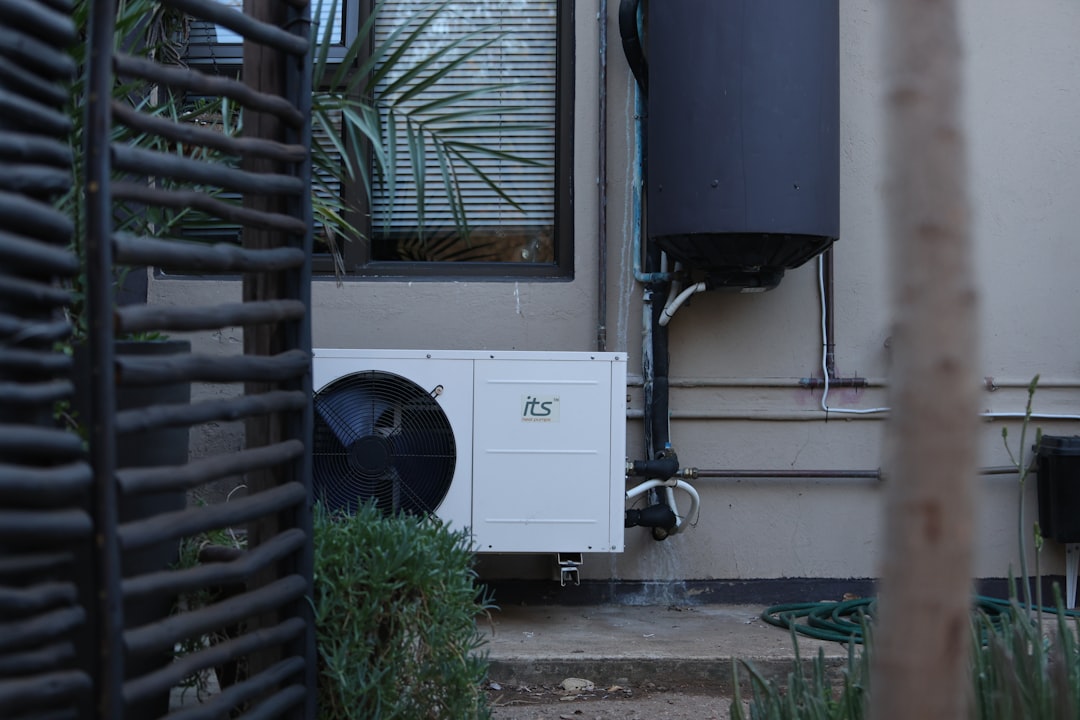
In contrast, a ductless mini split is a point-of-use system. It consists of an outdoor condenser connected to one or more indoor air handlers by small refrigerant lines. Instead of moving air through bulky ducts, it moves refrigerant directly to the room that needs cooling. This setup requires only a small three-inch hole in your exterior wall, making it a practical option when choosing the right AC installation service for a home where major remodeling is not ideal.

Zoning and Comfort: A Central AC vs Ductless Mini Split Comparison
One of the biggest frustrations for families in Ankeny or Johnston is the thermostat war. Someone wants the bedroom at 68 degrees, while another person is freezing in the living room.
Central AC handles this less precisely. Unless you install motorized dampers within your ducts, the whole house is often treated as one giant zone. Ductless mini splits, however, offer room-by-room control. Each indoor head has its own thermostat. You can turn off the cooling in the guest room while keeping your home office comfortable. This level of control is a major benefit of mini-split air conditioner services in Des Moines, IA for homeowners who want customized comfort.
Aesthetics and Indoor Air Quality
Aesthetics are often the biggest hurdle for mini splits. Some homeowners simply do not like the look of a white wall-mounted unit. Central AC is often preferred for being less visible, since the main components you see are floor or ceiling vents.
However, there is a trade-off with air quality. Central AC ducts can accumulate dust, pet dander, and allergens over the years. If those ducts are not sealed or cleaned, your system may keep recirculating that debris. Ductless systems eliminate this issue because there is no duct network carrying air from room to room. They use filtration right at the indoor unit, which can be helpful for allergy-sensitive households. If you’re looking for a deeper look at how these systems fit into your home’s structure, our AC installation Des Moines IA guide can help you visualize the best fit for your layout.
Central AC vs Ductless Mini Split Comparison: Efficiency and SEER2 Standards
As of May 2026, the industry has fully embraced SEER2 (Seasonal Energy Efficiency Ratio 2) as the standard for measuring cooling efficiency. This metric is more rigorous than the old SEER rating and is designed to reflect more realistic operating conditions.
In the central AC vs ductless mini split comparison, ductless systems are often the stronger option for raw efficiency. While high-efficiency central AC units may reach into the low-to-mid 20s SEER2 range, top-tier ductless models can achieve 30+ SEER2 ratings. This is largely due to inverter technology. Traditional single-stage central AC is like a car that only knows how to floor the gas or hit the brakes – it’s either fully on or fully off. Mini split inverters act more like a dimmer switch, adjusting compressor output to maintain a steady temperature without frequent energy-intensive startup cycles. For homeowners interested in getting the most from this technology, following effective mini-split installation tips helps support proper airflow and performance.
The Impact of Ductwork on Efficiency
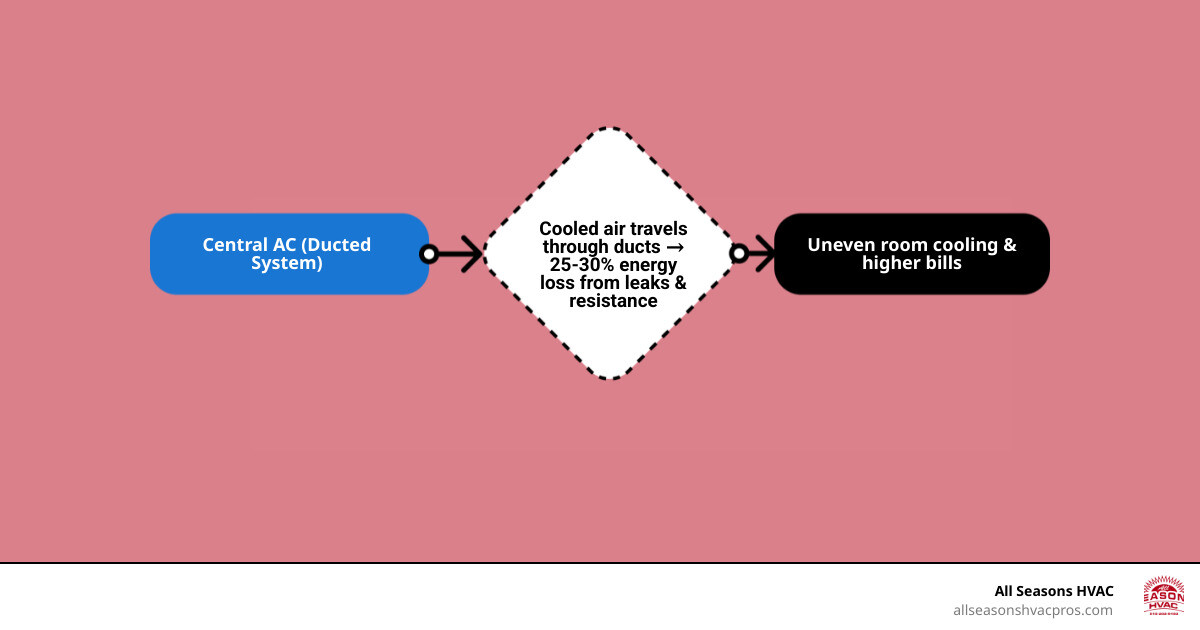
The “duct tax” is real. Research shows that typical duct systems can lose 25% to 30% of cooling energy through leaks, poor insulation, or thermal bridging. Imagine paying to cool your home but losing a large share of that conditioned air before it reaches the rooms you actually use.
In older Central Iowa homes, ducts often run through unconditioned attics where temperatures can become extremely high in July. That means your ducts can warm up the air you just paid to cool. Ductless systems avoid this entirely by delivering conditioned air directly into the room. If your current central system feels like it’s struggling, the ultimate guide to central air replacement in Carlisle, IA can help you understand whether ductwork issues may be affecting comfort.
Long-Term Value: Central AC vs Ductless Mini Split Comparison
While the equipment and installation approach can vary between these systems, long-term performance often tells a different story. Homeowners who switch to high-efficiency ductless systems often reduce cooling demand, especially when zoning is used properly.
In addition, federal heat pump incentives may still be available for qualifying systems, and many mini splits fall into that category because they provide both heating and cooling. Depending on eligibility and current program rules, that can strengthen the long-term value of ductless technology. For a broader look at planning an upgrade, our complete HVAC replacement guide Des Moines is a helpful resource.
Installation Flexibility for New and Existing Homes
The first decision point for any homeowner is the state of the home’s infrastructure. If you live in a historic home in Des Moines built before the 1950s, you may not have the wall cavity space for traditional bulky ducts. In these cases, installing central AC may require opening plaster walls or lowering ceilings to make room for duct runs.
Ductless mini splits are often the more flexible retrofit solution. They are ideal for slab-on-grade homes, historic properties, or any layout where adding ductwork would be disruptive.
Solutions for Specific Home Layouts
We often see nuisance rooms in Central Iowa – that one bedroom over the garage that stays several degrees warmer, or a finished basement that always feels too cold.
- Finished basements: Often lack the ceiling clearance for new ducts.
- Sunrooms: Large windows create a heavy heat load that central AC may not handle evenly.
- Garage conversions: A good fit for a single-zone mini split without forcing major changes to the main system.
- Attic suites: Often the hottest part of the house, where a dedicated mini split can provide needed support.
If you’re considering adding climate control to one of these spaces, mini-split installation in Ankeny, IA or mini-split installation in Waukee, IA offers a streamlined solution that does not require a whole-house overhaul.
Hybrid HVAC Configurations
You do not always have to choose one or the other. Many homeowners in Norwalk and Indianola use a hybrid HVAC strategy. They keep their central AC for the main living areas but add a mini split to a primary suite, sunroom, or home office.
This approach can solve a specific comfort problem without requiring a full system change. Learn more about how these setups can work through mini-split installation in Norwalk, IA.
Performance and Comfort in the Central Iowa Climate
Iowa weather is a test of endurance. We need systems that can handle 95-degree humidity in August and -10-degree wind chills in January.
Modern “cold-climate” mini split heat pumps have come a long way. Many models can now provide effective heat even when outdoor temperatures drop well below zero. For many homeowners, a mini split can actually replace an old, inefficient electric or propane furnace, providing a two-for-one solution.
Heating Capabilities in Extreme Cold
While central AC is strictly for cooling, mini splits are almost always heat pumps. In our region, we often recommend pairing a mini split with a backup heating source—like a dual-fuel setup—for those rare nights when temperatures hit record lows. However, for most of the year, the energy-efficient warmth provided by a ductless system is more than enough. If you’re curious about how these systems hold up in local winters, our page on mini-split air conditioner in Urbandale, IA provides more localized insights.
Supplemental heating is also a major draw for areas like sunrooms. Instead of running expensive electric space heaters, a mini split provides consistent, affordable warmth. Check out our services for mini-split air conditioner in Indianola, IA to see how we help neighbors stay cozy year-round.
Noise Levels and Operational Sound
If you’re sensitive to noise, the central AC vs ductless mini split comparison has a clear winner. Central AC systems have that familiar “whoosh” of air through the vents and a loud “clunk” when the outdoor compressor kicks on.
Indoor mini split units are remarkably quiet, often operating between 19 and 26 decibels. To put that in perspective, a whisper is about 30 decibels. You can sleep with a mini split running right above your head and barely hear a hum. This “whisper-quiet” operation is one of the top reasons homeowners choose mini-split air conditioner in Norwalk, IA for bedrooms and nurseries.
Maintenance Requirements and System Longevity
Both systems require professional care to reach their full lifespan, which is typically 15-20 years for central AC and can be 20-30 years for high-end ductless systems.
The maintenance tasks, however, are different:
- Central AC: You need to change the 1-inch or 4-inch pleated filter every 1-3 months. You also need to ensure the ductwork is sealed and clean.
- Mini Splits: These use permanent, washable filters. You should rinse them in the sink every 2-4 weeks. Because there are no ducts, you also need to ensure the “blower wheel” inside the head stays clean to prevent mold or odors.
Our technicians for mini-split installation emphasize that consistency is key. A neglected mini split will lose its efficiency advantage quickly if the filters are clogged with pet hair or dust.
Ensuring Long-Term Reliability
For both systems, an annual professional tune-up is non-negotiable. We check refrigerant levels, clean the outdoor coils, and ensure the condensate drainage is clear. In Iowa, where cottonwood seeds and grass clippings can clog an outdoor unit in a single season, this cleaning is vital for longevity. If you’re in Indianola, our mini-split installation in Indianola, IA services include comprehensive guidance on keeping your system running like new.
Improving Indoor Air Quality
We’ve touched on filtration, but dehumidification is the other half of the comfort equation. Because mini splits use inverter technology to run for longer, lower-intensity cycles, they are actually better at pulling humidity out of the air than a traditional central AC that cycles on and off rapidly. This prevents that “clammy” feeling on a humid July afternoon in Waukee. Explore our mini-split air conditioner in Waukee, IA options to see how we tackle humidity.
Frequently Asked Questions about Home Cooling
Which system is better for a home without existing ductwork?
Ductless mini splits are almost always the better choice. Retrofitting a home with ducts is invasive, expensive, and often requires sacrificing closet space or ceiling height. A mini split provides the same (or better) cooling power with just a small hole in the wall.
Can I use both central AC and mini-splits together?
Absolutely. This is called a hybrid configuration. It’s a smart way to keep your existing central system while solving specific “hot spots” in your home, like a new sunroom or a converted attic.
How do SEER2 ratings differ between the two systems?
Ductless systems generally have much higher SEER2 ratings (up to 38+) compared to central AC (typically capping at 21-26). When you combine the higher SEER2 rating with the lack of duct energy loss, a mini split is significantly more efficient.
Conclusion
The central AC vs ductless mini split comparison does not have a one-size-fits-all answer. The right choice depends on your home’s layout, existing ductwork, comfort goals, and efficiency priorities. If you have a large, newer home with properly designed ducts, central AC can be a solid and discreet option. If you are dealing with an older home, a new addition, or rooms that never seem comfortable, a ductless mini split may be the better fit.
At All Seasons HVAC LLC, we help Central Iowa homeowners choose practical heating and cooling solutions for their specific homes. Whether you’re in Des Moines, Ankeny, Waukee, or another nearby community, our team provides expert home comfort assessments and budget-friendly financing plans to support energy-efficient upgrades. Ready to explore the best setup for your home? More info about HVAC services is just a click away.