
Why Shade, Insulation, and Sealing Are Your AC’s Best Friends This Summer
Understanding how shade insulation and sealing reduce your AC workload could be the most practical thing you do for your home before summer hits Des Moines. When your AC is fighting against heat pouring in through your attic, leaking in around your doors, and radiating off a sun-baked condenser, it has to run longer and harder just to keep up — and that shows up on your energy bill every single month.
Here is a quick breakdown of how each strategy helps:
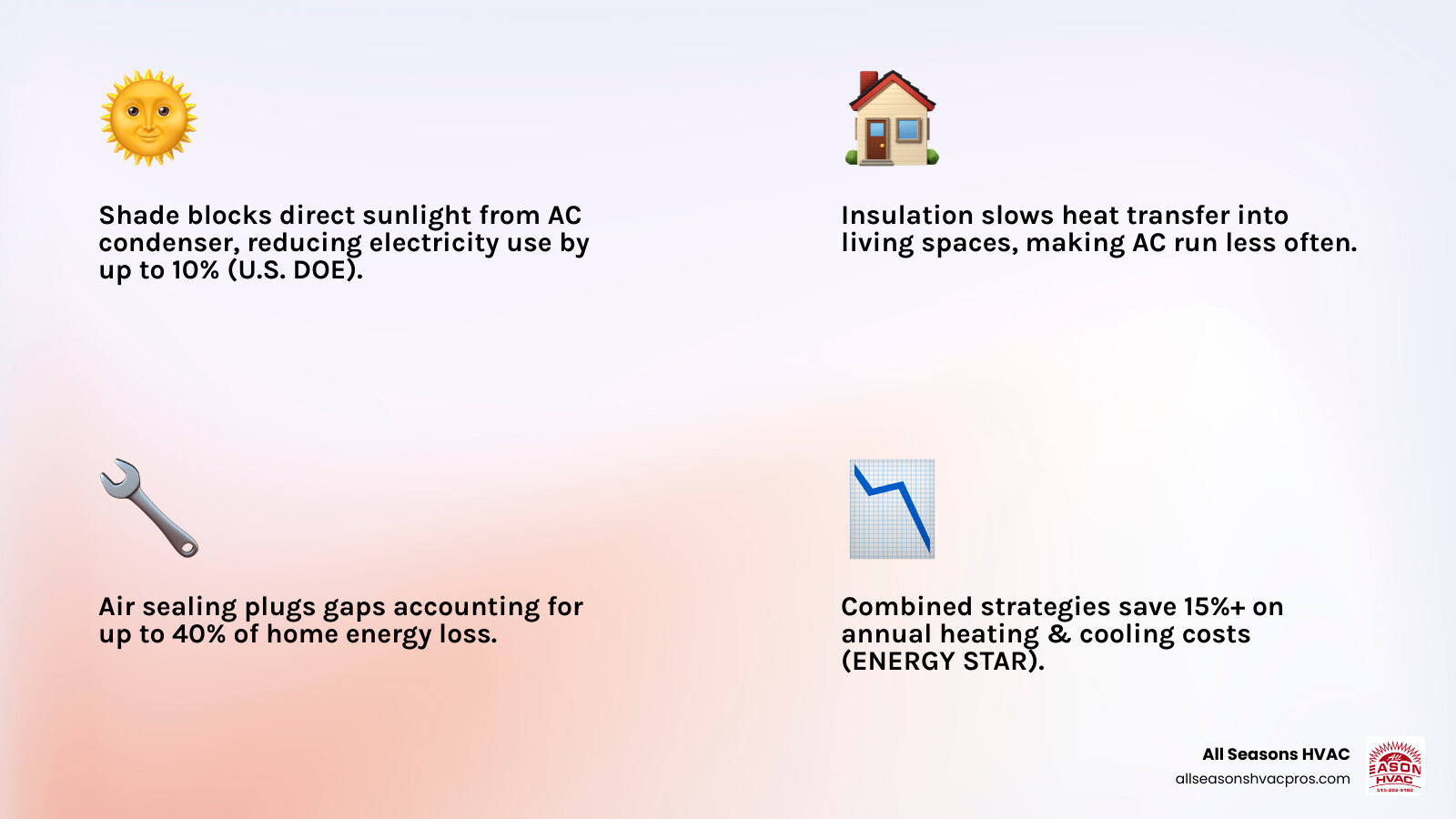
- Shade — Blocking direct sunlight from hitting your outdoor AC condenser can reduce the unit’s electricity use by up to 10%, according to the U.S. Department of Energy. Shade also lowers the temperature of the air your unit has to work with.
- Insulation — A well-insulated home (especially in the attic) slows heat from transferring into your living spaces, so your AC runs less often and for shorter cycles.
- Air sealing — Gaps and cracks around doors, outlets, and attic penetrations can account for up to 40% of your home’s energy loss. Sealing those leaks keeps cool air in and hot air out.
- Combined impact — The U.S. Department of Energy and ENERGY STAR report that proper insulation and air sealing together can save homeowners an average of 15% or more on annual heating and cooling costs.
The bottom line: your AC does not cool your home in isolation. The entire thermal envelope of your house — its walls, attic, windows, and seals — either helps or hurts how hard that system has to work. In Iowa’s hot, humid summers, every gap and unshaded surface adds up fast.
How shade insulation and sealing reduce your ac workload word list:
The Science of Heat Transfer and Your AC Workload
To understand how we can help our air conditioners, we first have to understand the enemy: heat. Heat is a restless traveler; it always wants to move from where it is hot to where it is cool. In a Des Moines July, that means the sweltering outdoor air is constantly trying to break into your 72-degree living room.
There are three main ways heat hitches a ride into your home:
- Radiation: This is heat moving via infrared light. Think of the sun’s rays hitting your roof or your west-facing windows. This is often the biggest contributor to Why Your Ac Is Not Cooling Properly during the peak afternoon hours.
- Conduction: This is heat moving through solid objects. If your wall studs or window frames aren’t properly insulated, they act as “thermal bridges,” literally carrying the heat from the outside siding directly to your indoor drywall.
- Convection: This is heat moving through the air. Every time hot air leaks in through a gap in your door or a “stack effect” pulls humid air up from your crawlspace, that’s convection at work.
When these three forces work together, your attic can reach a staggering 140°F. That massive heat reserve then “pushes” against your ceiling, forcing your AC to run nearly around the clock just to maintain a comfortable temperature.
How direct sunlight increases the workload on your AC unit
Direct sunlight is more than just bright; it carries a massive “heat load” measured in BTUs (British Thermal Units). Research shows that direct sun can add between 1,500 and 2,500 BTUs per hour of extra heat to your AC condenser cabinet alone.
When the sun beats down on that metal box, it raises the surface temperature by 20°F or more. This makes it significantly harder for the unit to shed the heat it gathered from inside your house. If the unit can’t dump that heat efficiently, the internal pressure rises, and the compressor has to work much harder. Over time, this intense stress can lead to mechanical failure or even Ac Refrigerant Leak Signs as components expand and contract under extreme heat.
Understanding the role of the outdoor condenser
Think of your AC as a heat sponge. The indoor coil soaks up the heat, and the outdoor condenser’s job is to “wring it out.” However, it’s a lot harder to wring out heat into 100-degree air than into 85-degree air.
The condenser relies on a massive volume of ambient air to cool the refrigerant. A typical 3-ton unit moves about 168,000 cubic feet of air every hour! If that air is superheated by the sun or trapped by poor landscaping, the heat rejection process slows down. This is why Solving Poor Ac Airflow Problems is the first step we take when a system isn’t keeping up.
How shade insulation and sealing reduce your ac workload
By addressing the “shell” of your home, you are essentially building a fortress that protects your AC unit. When we talk about how shade insulation and sealing reduce your AC workload, we are talking about creating a microclimate. If the air around your AC unit and the surfaces of your home are even 10 degrees cooler, your system doesn’t have to fight nearly as hard.
Strategically shading your outdoor unit can improve efficiency by up to 10%. Combined with sealing and insulation, you aren’t just saving money; you are extending the life of your equipment. A system that runs 12 hours a day will last years longer than one forced to run 20 hours a day because the house is “leaky.”
While you’re working on the exterior, don’t forget the interior vents. Keeping the system clean is just as vital; check our Fixing Ac Odors Maintenance Tips to ensure your indoor air is as fresh as it is cool.
Best methods for shading an AC unit without restricting airflow
Shading your AC is a bit of a balancing act. If you “choke” the unit with a solid cover or tight bushes, you’ll actually make it work harder by trapping its own exhaust air. Here is how to do it right:
- Lattice Panels: These are excellent because they block direct sunlight while allowing the wind to whistle through.
- Deciduous Trees: Planting trees like Red Maples or American Hollies provides lush shade in the summer but drops leaves in the winter, allowing the sun to help melt snow and ice around the unit.
- The 5-Foot Rule: Always maintain at least 5 feet of vertical clearance above the unit. Your AC blows hot air out the top; if that air hits a roof or awning and bounces back down, the unit will overheat.
- The 2-Foot Rule: Keep at least 2 to 3 feet of open space on all sides for maintenance access and side-intake airflow.
If you hear your Ac Making Your Home Humid or notice the Is Your Ac Making Strange Noises, it could be a sign that your shading is too restrictive and the unit is struggling to breathe.
How shade insulation and sealing reduce your ac workload through landscaping
Landscaping isn’t just for curb appeal; it’s a functional cooling tool. South-facing and west-facing windows are the biggest “heat leaks” in most homes. A single square foot of unshaded glass on the west side can admit as much heat as 30 square feet of insulated wall!
- Awnings: These can block up to 77% of solar heat gain before it even touches your window glass.
- Natural Windbreaks: In places like Waukee or Grimes, where the wind can whip across the plains, shrubs can act as a buffer, preventing hot summer gusts from pushing heat into your siding.
- Ground Covers: Using plants instead of rocks or concrete around your home’s foundation reduces “thermal bounce”—the heat that reflects off hard surfaces and back into your walls.
Addressing these exterior factors helps prevent Ac Thermostat Issues In Waukee Homes where the sun might be tricking your sensors into thinking it’s hotter than it actually is.
Strengthening the Thermal Barrier with Insulation and Sealing
If shade is the “shield,” then insulation is the “armor.” Insulation is measured by its R-value, which stands for resistance to heat flow. The higher the R-value, the better it stops heat from conducting through your walls and ceilings.
In Iowa, we recommend high R-values because of our extreme temperature swings. For attics, you should aim for R-49 to R-60. If you can see your floor joists when you look into your attic, you likely don’t have enough insulation.
| Insulation Type | R-Value per Inch | Best Use Case |
|---|---|---|
| Fiberglass Batts | 2.9 – 3.8 | Standard wall cavities and open attics |
| Blown-in Cellulose | 3.1 – 3.8 | Existing attics and hard-to-reach nooks |
| Spray Foam (Closed Cell) | 6.0 – 7.0 | Areas requiring both insulation and air sealing |
| Rigid Foam Board | 4.0 – 6.5 | Exterior sheathing or basement walls |
Properly insulating your ductwork is also critical. Leaky or uninsulated ducts in a hot attic can decrease cooling efficiency by as much as 20% before the air even reaches your vents.
Common air leak locations and effective sealing techniques
Air sealing is often the “forgotten partner” of insulation. You can have three feet of insulation, but if there’s a hole for a plumbing pipe right next to it, the hot air will simply bypass the insulation.
Common “leak” culprits include:
- The Top Plate: The wooden board on top of your wall studs in the attic. Gaps here pull air from your living room into the attic.
- Plumbing Stacks: The large pipes that go through your roof.
- Recessed Lighting: Older “can” lights are notorious for venting your expensive cool air directly into the attic.
- Weatherstripping: Check the seals around your doors. If you can see daylight or feel a draft, you’re “cooling the neighborhood.”
If you notice your Why Is My Ac Leaking Water, it might actually be condensation forming because hot, humid outdoor air is leaking into a cool indoor space!
How shade insulation and sealing reduce your ac workload in the attic
The attic is the primary battlefield for home efficiency. Because heat rises (convection) and the sun beats down on the shingles (radiation), the attic becomes a pressurized box of heat.
- Radiant Barriers: These are reflective foils installed on the underside of your roof. They reflect up to 97% of radiant heat back out of the house.
- Spray Foam: This is a “one-two punch” because it provides a high R-value and seals air leaks simultaneously.
- Stack Effect: Sealing the top of the house prevents the “vacuum” that pulls hot air in from the bottom of the house.
When the attic is properly managed, your AC doesn’t have to work nearly as hard. This prevents issues like a How To Fix A Frozen Ac Evaporator Coil, which often happens when a system runs too long without a break because it’s fighting an overheated attic.
Real-World Savings and Regional Strategies for Iowa Homeowners
Is it worth the effort? Absolutely. The Department of Energy estimates that the average homeowner can save 15% on heating and cooling costs just by air sealing and adding insulation. In a climate like Des Moines, where summer humidity can be just as brutal as the heat, these savings are even more pronounced.
By reducing the workload, you aren’t just saving on your monthly bill; you’re avoiding the “early retirement” of your AC unit. A system that isn’t strained is less likely to break down on a 95-degree Sunday afternoon.
Impact of humid climates on cooling strategies
In Central Iowa, our AC units have two jobs: lowering the temperature (sensible heat) and removing moisture (latent heat). When your home is poorly sealed, humidity hitches a ride on every air leak. This makes the air feel “heavy” and forces your AC to run longer cycles just to dehumidify the space.
Proper vapor barriers and air sealing are essential to prevent mold growth and ensure your home doesn’t feel like a sauna. If your system is blowing air but the house still feels “muggy,” check out Heat Pump Blowing Cold Air Causes to see if your system’s dehumidification cycle is struggling.
Incentives and rebates for energy-efficient upgrades
The good news for homeowners in Ankeny, Johnston, and West Des Moines is that you don’t have to go it alone. Many utility companies in Central Iowa offer rebates for adding attic insulation or upgrading to high-efficiency, high-SEER2 AC units.
Additionally, federal tax credits (like those under the Inflation Reduction Act) can cover a significant portion of the cost for weatherization and energy-efficient HVAC replacements. If your current unit is over 10-12 years old and struggling, these incentives make it a great time to look for Signs You Need Ac Replacement.
Avoiding Common Mistakes and Knowing When to Call a Pro
While there are plenty of small things you can do, like changing filters or adding weatherstripping, some tasks require a professional touch.
Common DIY pitfalls to avoid:
- Over-insulating: Yes, you can have too much of a good thing. If you block your attic soffit vents with insulation, you’ll trap moisture, which leads to mold and roof rot.
- Tightly Enclosing the AC: As we mentioned, never use a solid fence or tarp to shade your unit.
- Ignoring the “Why”: If your AC won’t turn on, it might not be the heat; it could be an electrical issue. Check What To Do When Ac Wont Turn On before you start climbing in the attic.
When to schedule professional AC maintenance
We recommend a professional tune-up at least once a year. While you can handle How To Fix Your Ac Without Calling The Cavalry for simple things like thermostat batteries, a pro needs to check refrigerant levels and deep-clean the condenser coils. A dirty coil can increase energy usage by over 30%!
Identifying critical system failures
If you’ve added shade and insulation but your system is still “short cycling” (turning on and off every few minutes), you might have a mechanical issue. Ac Short Cycling Causes can range from oversized units to failing capacitors. Similarly, Common Ac Electrical Problems should always be handled by a licensed technician to ensure your home stays safe.
Frequently Asked Questions about AC Workload
Does shading my AC unit really save 10% on energy?
Yes, according to the Department of Energy and multiple university studies, shading the outdoor unit can improve efficiency by up to 10%. However, this only works if you maintain proper airflow. If you restrict the air, you could actually increase your energy use.
What are the most common air leak locations in a home?
The “Big Three” are the attic (plumbing stacks and top plates), the basement (where the wood frame meets the concrete foundation), and windows/doors. Don’t forget electrical outlets on exterior walls; they are often hidden sources of drafts!
Can I over-insulate my attic and cause moisture issues?
You can’t really have “too much” R-value, but you can have “too little” ventilation. It is vital that your attic can still “breathe” through soffit and ridge vents. If you seal the vents, moisture from your bathrooms and kitchen will get trapped, leading to mold.
Conclusion
At All Seasons HVAC LLC, we believe that home comfort shouldn’t be a luxury. By understanding how shade insulation and sealing reduce your AC workload, you can take control of your home’s “microclimate” and give your cooling system the break it deserves.
Whether you need a professional energy audit, a seasonal tune-up, or a full system upgrade, we are here to help our neighbors in Des Moines, Ankeny, Waukee, and beyond. We offer budget-friendly financing plans to make sure you can stay cool all summer without the financial stress.
Don’t let the Iowa sun dictate your comfort. Schedule your professional cooling assessment in Des Moines today and let us help you “seal the deal” on a more efficient home!