
What to Expect: AC Replacement Timeline for Des Moines Homeowners
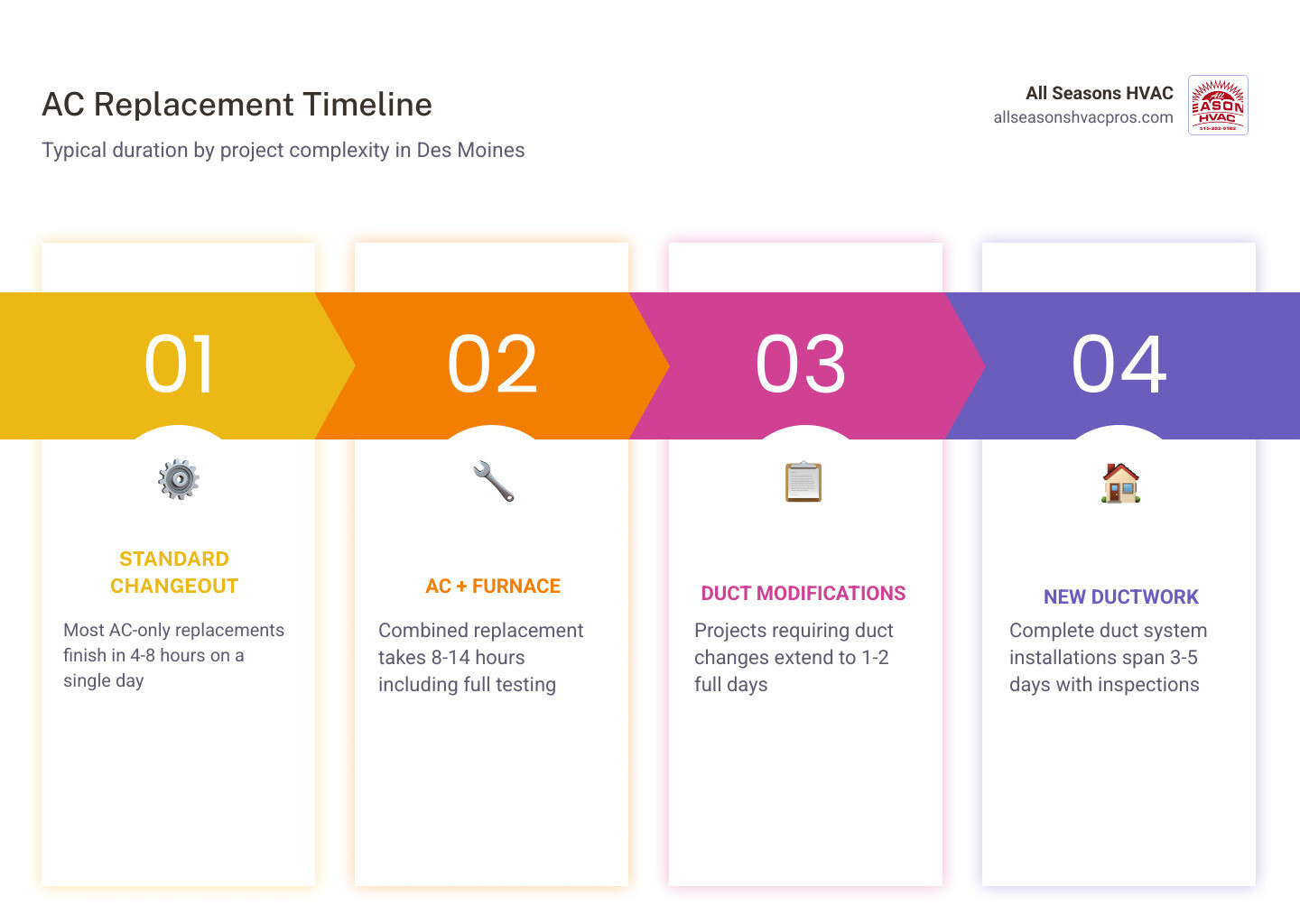
How long does an ac replacement take is one of the first questions homeowners ask when their system gives out — especially during an Iowa summer. The short answer: most standard AC replacements take 4 to 8 hours and are completed in a single day.
Here is a quick look at typical timelines by job type:
| Job Type | Estimated Time |
|---|---|
| Standard AC-only changeout | 4–8 hours |
| AC + furnace replacement | 8–14 hours |
| AC replacement with duct modifications | 1–2 days |
| Full system with new ductwork | 3–5 days |
| Heat pump upgrade (with electrical work) | 1–2 days |
That said, your actual timeline depends on several factors — including the type of system, your home’s layout, ductwork condition, and whether permits are required. The sections below walk you through each one so you can plan ahead with confidence.
If your system has already stopped keeping up, the last thing you want is to be caught off guard on a 95-degree Des Moines afternoon without a clear picture of how long you’ll be without cooling.
Easy how long does an ac replacement take word list:
How Long Does an AC Replacement Take on Average?
When we talk about a standard timeline for replacing an air conditioner, the physical swap itself is surprisingly fast. For a professional, experienced crew, a straightforward, like-for-like changeout typically takes between 4 to 8 hours. This means that if our team arrives at your home in the morning, you will usually have cold air blowing again by dinner time.
However, it is important to distinguish between a simple “changeout” and a completely new system installation.
- An AC Changeout: This is a direct swap of your old indoor evaporator coil and outdoor condenser unit with new, highly efficient models. If your existing ductwork is in great shape, this is the fastest type of project and easily wraps up in less than a day. To learn more about standard setups, check out our AC Installation Des Moines IA Guide.
- A New System Installation: If you are installing central air conditioning in an older home that has never had it before, or if your home requires completely new ductwork, the timeline expands. This type of project can take anywhere from 3 to 5 days because it involves running new lines, cutting vents, and sealing a brand-new distribution system. For a deep dive into surviving this process, read through our AC Replacement in Ankeny IA: A Homeowner’s Survival Guide.
Key Factors Determining How Long Does an AC Replacement Take
Several variables dictate whether your installation falls closer to the 4-hour mark or stretches into a multi-day project.
First is home volume and system size. Larger homes require larger units, which can sometimes mean more complex handling and positioning. Second is equipment location. Swapping an outdoor condenser sitting on a flat, easily accessible concrete pad next to your driveway is a breeze. Moving a heavy indoor air handler out of a tight, low-ceiling crawl space or a hot attic takes significantly more time.
Finally, accessibility plays a major role. If our technicians have to navigate narrow basements, winding stairs, or tight closets to access your indoor components, the project will naturally take a bit longer. For a comprehensive look at these variables, you can reference The Definitive Guide to What to Expect During AC Replacement.
How Long Does an AC Replacement Take When Upgrading to a Heat Pump?
Many homeowners in the Des Moines metro area are choosing to transition from traditional air conditioners to modern, energy-efficient heat pumps. Because heat pumps provide both heating and cooling, they are incredibly versatile.
When upgrading to a heat pump, the physical installation of the outdoor unit is similar to a standard AC, but the timeline can sometimes stretch to 1 to 2 days. This is because a heat pump transition often requires:
- Electrical Upgrades: Heat pumps may require different electrical loads, meaning we might need to modify your electrical panel or run new wiring to support the system.
- Dual-Fuel Integration: If you are keeping your existing furnace as a backup heating source for those freezing Iowa winters, we must carefully calibrate the new heat pump to work seamlessly alongside your furnace.
If you are trying to decide whether it is time to make this transition, review the key Signs You Need AC Replacement.
Key Factors That Influence Your Installation Timeline
Understanding the unique layout of your home is the best way to estimate how long we will be working on-site. The physical structure of your house, the type of system you choose, and the state of your existing infrastructure all play a part. To help you visualize this, we have broken down the average timelines based on project complexity:
| System & Complexity | Expected On-Site Duration |
|---|---|
| Packaged Unit (Roof or Ground) | 4–6 Hours |
| Standard Split System (Basement/Garage) | 4–8 Hours |
| Split System with Tight Attic Access | 6–10 Hours |
| System Swap + Minor Duct Repairs | 1–2 Days |
| Full System + Complete Ductwork Replacement | 3–5 Days |
Before we begin any work, we always perform a detailed assessment. This includes looking at your air distribution system. To understand how we do this, read our guide on How to Assess Ductwork During AC Replacement.
System Type and Home Layout
The physical design of your HVAC system dictates the speed of the replacement. Split systems—which are the most common in Central Iowa—have an outdoor condenser and an indoor evaporator coil. Swapping both parts requires connecting refrigerant lines between the inside and outside of your home, which takes a steady, methodical approach. Packaged units, which house all components in a single outdoor cabinet (often installed on a flat roof or a ground pad), are generally quicker to swap out because all the main connections are in one place.
Your home’s layout also introduces specific challenges. For example:
- Attic Access: If your indoor unit is in the attic, our technicians must carefully navigate joists, protect your ceilings, and work in high temperatures, which naturally slows down the physical labor.
- Crawl Spaces: Low-clearance crawl spaces limit movement and make transporting heavy equipment a slower, more precise task.
Ductwork Condition and Code Upgrades
Even the most advanced, high-efficiency air conditioner will struggle if your ductwork is failing. If we discover leaky, crushed, or poorly insulated ducts during our pre-installation inspection, we will recommend repairs. Fixing these issues can add a day or more to the timeline, but it ensures you actually get the energy savings you are paying for.
Additionally, building codes change. If your home has older electrical wiring or gas connections, we may need to make electrical modifications to bring your system up to current safety standards. Local municipalities in the Des Moines area also require permit inspections for new HVAC installations. While pulling a permit doesn’t usually slow down the work on installation day, scheduling the follow-up city inspection can add a brief step to the overall project wrap-up. For more details on local regulations and standards, check out our HVAC Installation Des Moines IA Guide.
Step-by-Step: What to Expect on Installation Day
Knowing what happens hour-by-hour can take the stress out of your AC replacement. Here is how a typical installation day unfolds when our team arrives at your home.
Phase 1: Arrival, Assessment, and Old Unit Removal
Our team will arrive in a fully stocked service truck, introduce themselves, and do a quick walkthrough of the work areas.
- Workspace Protection: We lay down drop cloths and floor protectors to keep your home clean.
- Refrigerant Recovery: Per EPA guidelines, we cannot simply cut the lines of your old AC. We use a specialized recovery machine to safely and legally vacuum out the old refrigerant. This step takes about 45 to 60 minutes.
- Deconstruction: Once the lines are safe, we disconnect the electrical wiring, unbolt the old condenser and indoor coil, and carefully haul them away.
Phase 2: Installing and Testing the New System
With the old equipment out of the way, the precision work begins.
- Site Preparation: We level the outdoor pad and inspect the indoor plenum (the box connecting your AC to your ducts).
- Equipment Placement: We position the new indoor coil and outdoor condenser.
- Line Set & Electrical Connections: We run new copper refrigerant lines, braze them securely to prevent leaks, and complete the electrical hookups.
- Vacuuming the System: We run a vacuum pump on the new lines to remove all moisture and air. This is crucial—if moisture remains, it can ruin your new compressor. This process typically takes about 1 hour.
- Thermostat Calibration & Startup: We install your new thermostat, charge the system with fresh refrigerant, and turn it on.
- Testing and Walkthrough: We measure airflow, check system pressures, and walk you through how to use your new system.
How Homeowners Can Prepare to Minimize Cooling Downtime
While our technicians handle the heavy lifting, there are a few simple things you can do to keep the project moving quickly and minimize the time your home is without air conditioning. If you are currently dealing with a system that is struggling but not yet ready for replacement, you might want to look into AC Repair Ankeny IA to see if a quick fix can buy you some time.
Preparing Your Home Before the Technicians Arrive
A little preparation goes a long way. To help us get straight to work, please consider the following:
- Clear the Area: Ensure there is at least three feet of clear space around both your indoor air handler (in the basement, closet, or attic) and your outdoor condenser unit.
- Provide Path Access: Move any fragile items, furniture, or toys out of the hallways and stairwells our team will be walking through.
- Secure Your Pets: The frequent opening of doors and the noise of power tools can be stressful for pets. Keeping them in a quiet, secure room or arranging for them to stay with a neighbor will keep them safe and let our team work efficiently.
- Ensure Electrical Panel Access: Make sure our technicians have clear, unobstructed access to your home’s main electrical panel.
Managing Comfort During the 4 to 8 Hour Cooling Downtime
Because your power and cooling will be turned off during the installation, your home will start to warm up. To stay comfortable:
- Pre-Cool Your Home: Run your old AC a few degrees lower than usual the night before your installation to “cool down” the physical structure of your home.
- Close the Blinds: Keep drapes and blinds pulled tight on the sunny sides of your house to block out radiant heat.
- Use Fans: Ceiling fans and portable box fans don’t cool the air, but the breeze they create will help you feel much cooler while the system is off.
Frequently Asked Questions About AC Replacement Timelines
Does getting a permit slow down the installation process?
No, getting a permit will not delay your actual installation day. We handle all the paperwork and pull the necessary permits before we arrive at your home. The physical work is completed on schedule. Once the installation is finished, a local city inspector will need to visit your home to verify that everything meets local safety codes. This inspection is usually scheduled a few days after the installation and only takes about 15 minutes.
What is the fastest time of year to schedule a replacement?
The fastest times to schedule an AC replacement are the “shoulder seasons”—specifically spring (March to April) and fall (September to October). During these months, weather is mild, and HVAC companies are not swamped with emergency repair calls. If you schedule your replacement during the peak of summer, you may have to wait several weeks for an open appointment. Planning ahead allows you to get your system installed quickly and on your own terms.
Can I stay home while the technicians are working?
Yes, you can absolutely stay home! Most homeowners choose to remain at home during the installation. There will be some noise from power tools and technicians walking in and out, but our team works hard to keep disruptions to a minimum. We only ask that children and pets stay clear of the active work zones for their own safety.
Conclusion
While the question of how long does an ac replacement take depends on your home’s unique layout, most standard replacements are completed smoothly in a single day. Investing in a new, energy-efficient system not only restores your comfort but also lowers your monthly utility bills.
At All Seasons HVAC, we are proud to serve families across the Greater Des Moines metro area—from Ankeny and Waukee to West Des Moines, Norwalk, and beyond. We understand that a new cooling system is a major home investment, which is why we offer budget-friendly financing plans to ensure year-round comfort remains affordable for everyone.
Ready to plan your upgrade? Explore our Complete HVAC Replacement Guide Des Moines or reach out to us today to schedule your personalized consultation!