

Why Understanding How Ductwork Is Evaluated During AC Replacement Saves You Money and Comfort
How ductwork is evaluated during AC replacement is one of the most important — and most overlooked — parts of getting a new air conditioner. Most homeowners in Des Moines focus entirely on the new AC unit itself. But here’s the reality: a brand-new system is only as good as the ducts delivering its output. If your ductwork is leaky, undersized, or deteriorating, even the most efficient AC unit will struggle to keep your home comfortable.
Think of it this way — imagine spending thousands on a new air conditioner, only to find that certain rooms still feel stuffy in July while others are freezing. That’s exactly what happens when ductwork goes unevaluated before installation.
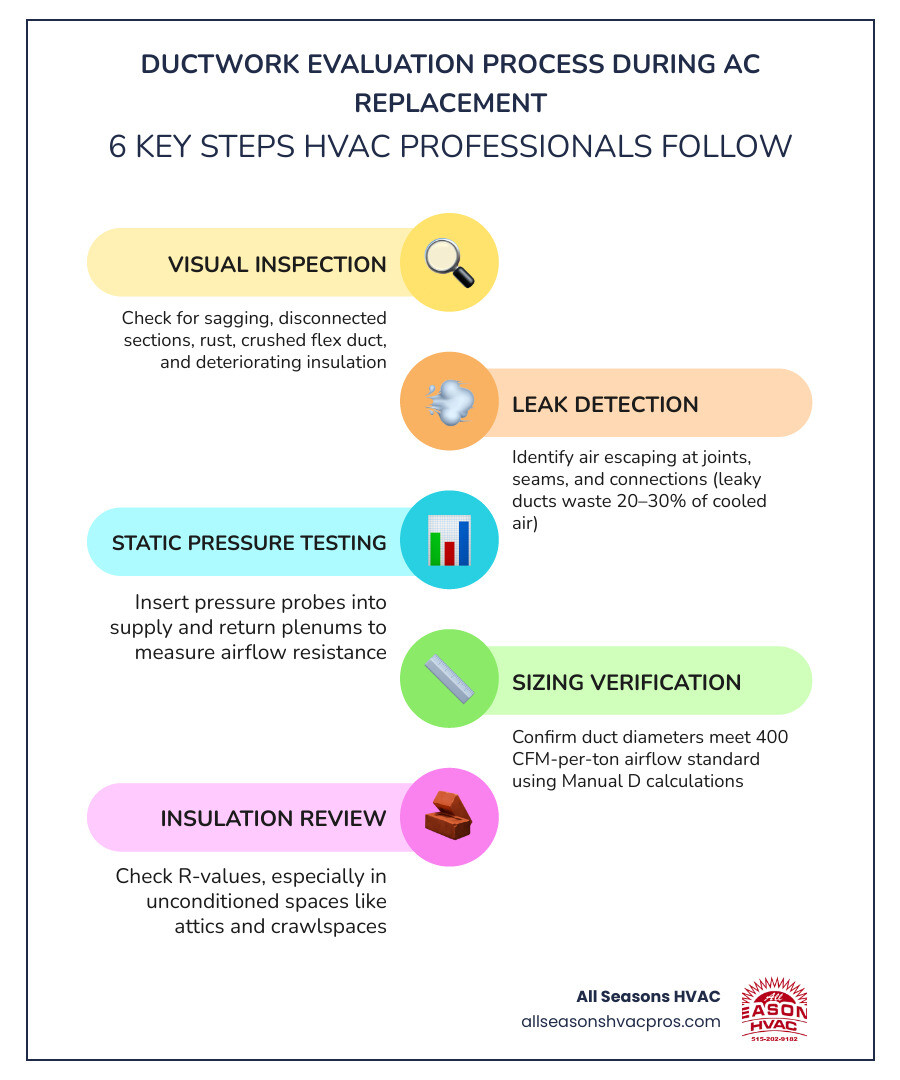
Here’s a quick overview of how professionals evaluate ductwork during AC replacement:
- Visual inspection – Check for sagging, disconnected sections, rust, crushed flex duct, and deteriorating insulation
- Leak detection – Identify air escaping at joints, seams, and connections (leaky ducts can waste 20–30% of cooled air)
- Static pressure testing – Insert pressure probes into supply and return plenums to measure airflow resistance
- Sizing verification – Confirm duct diameters meet the 400 CFM-per-ton airflow standard using Manual D calculations
- Insulation review – Check R-values, especially in unconditioned spaces like attics and crawlspaces
- Compatibility assessment – Verify existing ducts can support the airflow demands of modern, high-efficiency AC systems
Duct systems older than 15 to 20 years are frequently found to be failing, undersized, or leaking — and that age range lines up almost exactly with when most AC units need replacement too. That timing makes AC replacement the ideal moment to catch and correct duct problems before they silently drain your energy budget and your comfort.
Why Ductwork Evaluation is Critical During AC Replacement
When we install a new air conditioner in your Central Iowa home, we aren’t just placing a metal box outside and calling it a day. We are introducing a highly calibrated piece of machinery to your home’s existing air distribution system. If that distribution system is compromised, your new investment cannot perform as advertised.

The Direct Hit to Your Energy Bills and System Efficiency
Did you know that leaky or poorly insulated ducts can waste 20% to 30% of conditioned air before it ever reaches your living spaces? That is cooled air that you paid to condition, escaping directly into your attic, crawlspace, or wall cavities.
Furthermore, poorly installed or failing ductwork can reduce overall HVAC system efficiency by 10% to 40%. When air cannot flow freely, your system has to work twice as hard to cool your home. By ensuring your ductwork is in top-tier shape, quality ductwork can improve your system’s efficiency by 20% to 30%. If you are already noticing that your current system is struggling, it is important to review the Signs You Need AC Replacement to determine if both your unit and your ducts are reaching their end of life.
Safeguarding Your Equipment’s Lifespan
An air conditioner that has to push air through restricted or leaky ducts is under constant physical stress. This extra strain leads to overheating, frozen evaporator coils, and premature compressor failure. By taking the time to evaluate the ducts during a replacement, we ensure your new AC operates within its designed limits, protecting your equipment lifespan and preventing early breakdowns.
Indoor Air Quality and the Health of Your Home
Your ductwork behaves like the respiratory system of your home. When ducts are cracked, disconnected, or damaged by pests, they draw in dirty air from unconditioned areas. In Des Moines homes, this often means pulling in dust, insulation fibers, mold spores, and pest droppings from the attic or crawlspace and blasting them into your bedrooms.
Neglecting your duct integrity doesn’t just make your home dusty; it can lead to serious system failures and poor health. To learn more about these unseen dangers, read about the risks of airborne contaminants in From Dust to Bust: The Risks of Neglecting Your System.
How Ductwork is Evaluated During AC Replacement: The Professional Process
A professional ductwork evaluation is a systematic, data-driven diagnostic process. When our experienced technicians visit your home, we do not just glance at your vents. We perform a comprehensive physical and technical assessment to determine exactly how your ducts will interact with a modern cooling system.
Here is what you can expect during our professional step-by-step inspection:
- Accessing the System: We inspect all accessible portions of your ductwork in your basement, utility room, attic, or crawlspace.
- Physical Integrity Check: We look for physical damage such as crushed flexible ducts, disconnected joints, rusted metal, or sagging sections. We often find “octopus layouts” where flexible ducts are tangled over joists, which severely chokes airflow.
- Insulation and Vapor Barrier Review: We verify that your ducts are insulated properly, especially those running through unconditioned attics. We check for torn vapor barriers that can cause moisture condensation and mold growth.
- Leakage Diagnostics: We check for air leaks at every joint and connection. One common indicator we look for is “dust tracking” — dark lines of dust accumulating near duct seams, which acts like a physical fingerprint of an air leak.
- Static Pressure Testing: Using a specialized tool called a manometer, we insert physical pressure probes directly into the supply and return plenums. This measures the resistance to airflow within the system, giving us a clear picture of system health.
For a broader look at what to expect during the entire system upgrade, check out The Definitive Guide to What to Expect During AC Replacement.
How Ductwork is Evaluated During AC Replacement for Sizing and Airflow
Airflow is the lifeblood of air conditioning. In the HVAC industry, the gold standard for residential cooling is 400 CFM (Cubic Feet per Minute) per ton of cooling capacity. During an evaluation, we must verify that your duct system can physically handle this volume of air.
To do this, we use Manual D calculations, the industry-standard design protocol for residential duct systems. We measure the diameter of your trunk lines (the main distribution paths) and your branch ducts (the smaller pipes leading to individual rooms) and compare them to the requirements of your new unit.
A very common issue we discover in older Des Moines homes is a major bottleneck on the return air side. For example, if you are installing a new 3.5-ton AC system, it requires 1,400 CFM of total airflow (3.5 tons x 400 CFM).
If your home only has a single 16-inch return air duct, that duct can only safely handle approximately 1,050 CFM. This creates a massive 350 CFM shortfall. In this scenario, running a new AC on the old ductwork is like forcing a marathon runner to breathe through a cocktail straw. It chokes the system, causes the air to sound “angry” and noisy at the vents, and will quickly damage the new equipment.
How Ductwork is Evaluated During AC Replacement for Compatibility with Modern Systems
If your existing ductwork was installed in the 1990s or early 2000s, it was designed for a very different type of HVAC system. Older air conditioners utilized single-speed PSC (Permanent Split Capacitor) blower motors. These motors were rugged but highly inefficient, pushing air with brute force regardless of resistance.
Modern high-efficiency AC systems rely on sophisticated variable-speed blower motors (known as ECMs). These motors are designed to save energy by automatically adjusting their speed to maintain proper airflow. However, they are highly sensitive to duct design and static pressure:
- Variable-Speed Sensitivity: If connected to undersized or restricted ducts, a variable-speed motor will ramp up to its maximum speed to overcome the restriction. This defeats the energy-saving purpose of the motor, creates loud whistling noises, and can cause the motor to burn out prematurely.
- Strict SEER2 Standards: As of June 2026, federal SEER2 regulations require highly efficient and precise system performance. If your ductwork is restrictive, your brand-new system will fail to achieve its rated SEER2 efficiency, costing you more money on your monthly utility bills.
- Filtration Resistance: Modern homeowners often prefer high-efficiency MERV 11 or MERV 13 air filters to improve indoor air quality. These thicker filters add extra resistance to the system. During our evaluation, we calculate this filtration resistance to ensure your return ducts have the capacity to handle both the filter and the AC unit’s airflow needs.
Repairing vs. Replacing Your Ducts: Making the Right Choice
Once we complete our evaluation, we present you with our findings. Depending on the physical condition, age, and design of your ductwork, we will help you decide whether a targeted repair or a full replacement is the smartest choice for your home.
| Feature / Metric | Duct Sealing & Repair | Full Duct Replacement |
|---|---|---|
| Typical Lifespan | Extends existing duct life by 5 to 10 years | 15 to 20+ years (brand-new infrastructure) |
| Efficiency Gain | Improves system efficiency by 10% to 15% | Improves system efficiency by 20% to 30% |
| Best For | Structurally sound ducts with minor leaks at joints | Brittle, crushed, or rotting ducts; major layout errors |
| Insulation Standard | Keeps existing insulation (often R-2 or R-4) | Upgrades to modern R-8 insulated ductwork |
| Sizing Correction | Limited ability to fix major sizing bottlenecks | Completely custom-designed to match new AC airflow |
When to Choose Duct Sealing and Repair
If your ducts are structurally sound, properly sized, and laid out logically, a full replacement is unnecessary. Instead, we can focus on professional sealing and localized repairs.
We perform mastic sealing, which involves applying a professional-grade, paint-on mastic sealant reinforced with fiberglass mesh over all joints and connections. This is the absolute gold standard for duct sealing.
Note: Standard utility “duct tape” is ironically terrible for ductwork. It dries out, loses its adhesive qualities, and fails within a few years in a hot Iowa attic.
When Full Duct Replacement is Necessary
A full replacement is the best path forward if:
- Your existing flex ducting is brittle, peeling, or has extensive rodent damage.
- Your ducts are older than 20 years and have completely degraded insulation.
- Your duct system is severely undersized for the cooling capacity your home needs, and modifying the existing layout is physically impossible.
- The labor required to strip, clean, seal, and insulate your old ducts approaches the effort of starting fresh with modern materials.
Investing in properly designed ductwork ensures your home comfort system operates at peak performance. To understand how optimizing your system delivers long-term financial benefits, read about The Real ROI of Keeping Your HVAC Happy.
Frequently Asked Questions About Ductwork Inspections
To help you prepare for your upcoming AC replacement, here are the answers to the most common questions Des Moines homeowners ask us about the duct evaluation process.
How long does a professional ductwork inspection typically take?
A thorough, professional ductwork evaluation typically takes between 45 and 90 minutes.
During this window, our technician will need access to your indoor utility closet, basement, attic, or crawlspace. We will perform a physical walkthrough, take physical measurements of your duct diameters, and perform static pressure tests using our diagnostic tools. We recommend clearing any storage items away from your mechanical room and attic access points before we arrive to help the inspection go as smoothly as possible.
What are the risks of using undersized or leaky ducts with a new AC?
Using compromised ductwork with a brand-new, high-efficiency air conditioner carries several severe risks:
- Frozen Evaporator Coils: Restricted airflow prevents the warm indoor air from properly transferring heat to the refrigerant coils. This causes the coils to drop below freezing, turning your indoor unit into a block of ice and completely stopping the cooling process.
- Premature Compressor Failure: High static pressure forces the compressor in your outdoor unit to work significantly harder, leading to overheating and electrical failure.
- Loud System Noise: When too much air is forced through a tiny duct, it creates high-velocity air noise, resulting in a constant, distracting whistling or rushing sound whenever the system runs.
- Uneven Temperatures: Rooms furthest from the utility room will fail to receive adequate airflow, leaving them uncomfortably warm while rooms closer to the system freeze.
Is new ductwork automatically included with a standard AC installation?
No, a standard AC replacement does not automatically include new ductwork.
A standard installation focuses strictly on the mechanical equipment: the outdoor condenser unit, the indoor evaporator coil, the copper refrigerant lines, and the electrical connections. Because your ductwork is independent home infrastructure, it is treated as a separate system. This is why a dedicated professional evaluation is so critical — it ensures we identify any duct issues beforehand, preventing unexpected performance problems after your new air conditioner is installed.
Conclusion
At All Seasons HVAC LLC, we are committed to ensuring your home remains a comfortable, energy-efficient sanctuary all year long. We serve homeowners across the Greater Des Moines area, including Ankeny, Waukee, West Des Moines, Norwalk, Indianola, Grimes, Johnston, and surrounding Central Iowa communities.
When it is time to replace your air conditioner, we don’t take shortcuts. Our experienced, licensed technicians will perform a comprehensive ductwork evaluation to make sure your home’s “hidden highway” is perfectly matched to your new cooling system. To help make your upgrade as stress-free and affordable as possible, we also offer budget-friendly financing plans tailored to your family’s needs.
Are you ready to plan your system upgrade? Explore our comprehensive Complete HVAC Replacement Guide Des Moines or contact our friendly team today to schedule your professional AC replacement consultation and ductwork evaluation!