

Why Understanding How Mini Splits Provide Zone Comfort in Four-Season Weather Matters for Des Moines Homeowners
How mini splits provide zone comfort in four-season weather comes down to one core idea: instead of heating or cooling your entire home from a single system, you control the temperature in each room independently — and you can do it whether it’s a humid Iowa summer or a below-zero January night.
Here’s a quick summary of how it works:
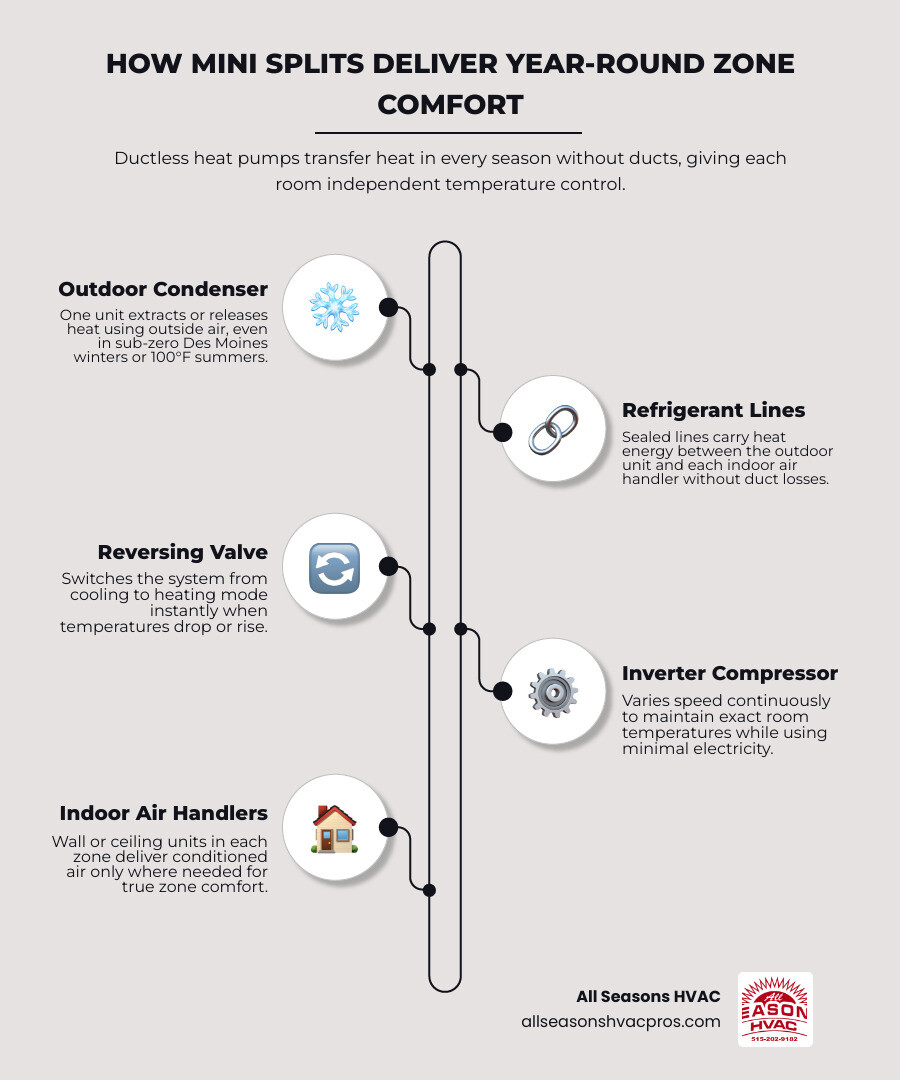
- One outdoor unit connects to multiple indoor air handlers placed in different rooms
- Each indoor unit has its own controls, so every zone gets its own temperature setting
- A reversing valve lets the system switch between heating and cooling depending on the season
- Inverter-driven compressors adjust output continuously instead of cycling on and off, keeping temperatures stable without energy spikes
- No ductwork means no energy lost through leaky or uninsulated ducts — conditioned air goes directly where it’s needed
If you’ve ever had a sunroom that felt like an oven in July, a finished basement that never quite warmed up in winter, or a bonus room that your central system simply couldn’t reach, a multi-zone mini split is designed to solve exactly those problems. And in a climate like Des Moines, where temperatures can swing from 100°F in summer to -10°F in winter, having a system that handles both extremes in every room of your home is more than a luxury — it’s a practical comfort solution.
How mini splits provide zone comfort in four season weather terminology:
- ductless mini split benefits for the des moines metro homes
- how ductless systems save energy with zone control
How Mini Splits Provide Zone Comfort in Four Season Weather
At its heart, a multi-zone ductless mini-split system is an incredibly flexible way to heat and cool your home. Unlike traditional central systems that push air through a complex maze of ducts, mini-splits deliver comfort directly to individual spaces. This is achieved by separating your home into independent zones, each managed by its own indoor air handler.
The system consists of one compact outdoor condenser unit connected to up to five indoor air handlers. These indoor units are linked to the outdoor compressor by small, non-invasive refrigerant lines, electrical wiring, and a condensate drain line, all bundled together inside a slim conduit. Because this conduit only requires a small three-inch hole through an exterior wall, installation is remarkably straightforward and preserves the structural integrity of your home.
By eliminating the need for bulky ductwork, mini-splits bypass a major source of energy waste. Traditional duct systems can lose up to 30% of their conditioned air through leaks, gaps, and poor insulation. When you eliminate the ducts, you keep that energy—and your money—right where it belongs. To learn more about these mechanisms, read The Definitive Guide to How Ductless Systems Save Energy with Zone Control.
Key Benefits of Multi-Zone Mini-Split Systems
- Personalized Temperature Control: Each family member can set their own perfect temperature in their respective zones. If someone prefers a cool 68°F bedroom for sleeping while another wants a cozy 72°F living room, both can coexist in perfect harmony.
- Targeted Energy Use: There is no need to waste energy heating or cooling empty rooms. You can easily scale back the climate control in a guest room, basement, or formal dining room when they are not in use, which can reduce your overall energy consumption by up to 35% compared to traditional central systems.
- Whisper-Quiet Operation: Because the noisy compressor is located outside, the indoor units operate at decibel levels as low as 19 to 25 dB. That is quieter than a whisper or a soft rustle of leaves, making them perfect for bedrooms, home offices, and nurseries.
- Flexible Aesthetic Options: Indoor units come in various styles to match your home’s decor. You can choose from classic wall-mounted units, low-profile floor mounts, ceiling cassettes that sit flush with the ceiling, or even concealed duct styles.
- Improved Indoor Air Quality: Without ducts to collect dust, pet dander, and allergens, mini-splits keep your air cleaner. Each indoor air handler features its own washable, multi-stage filtration system that captures airborne particles before they circulate.
The Mechanics of How Mini Splits Provide Zone Comfort in Four Season Weather
To understand how a mini-split can both cool your home on a sweltering August afternoon and warm it during a freezing January morning, we have to look at the science of heat transfer. Mini-splits do not actually “create” heat or cold; instead, they move thermal energy from one place to another.
During the summer, the system acts as a standard air conditioner. The indoor air handler absorbs heat from the air inside your room and transfers it to the refrigerant flowing through the coils. This refrigerant travels to the outdoor unit, where the compressor releases the heat into the outdoor air.
When winter arrives, the magic of the reversing valve comes into play. This specialized valve reverses the flow of the refrigerant, turning the outdoor unit into the heat collector and the indoor units into heat distributors. Even in very cold weather, there is still thermal energy present in the outdoor air. The outdoor unit extracts this heat, compresses the refrigerant to raise its temperature, and pumps it inside to warm your living spaces.
This process is incredibly efficient because moving heat takes far less electricity than generating it through electric resistance or burning fossil fuels. For a deeper dive into how this secret weapon can transform your home’s comfort, check out Ductless Heating and Cooling: A Des Moines Homeowner’s Secret Weapon.
Why Inverter Technology is Key to How Mini Splits Provide Zone Comfort in Four Season Weather
If the reversing valve is the muscle of the mini-split, inverter technology is its brain. Traditional HVAC systems operate on a simple “on/off” cycle. When the thermostat detects that the temperature has drifted, the system kicks on at 100% capacity, blasts conditioned air until the target temperature is reached, and then shuts down completely. This constant cycling is noisy, creates uncomfortable temperature swings, and consumes a massive amount of starting electricity.
Inverter-driven compressors, on the other hand, operate more like a dimmer switch. Instead of shutting off, the compressor continuously adjusts its motor speed to match the precise heating or cooling demand of your home at any given second. It can modulate its output down to as low as 20% capacity.
Once your home reaches the desired temperature, the inverter-driven mini-split runs at an ultra-low, steady speed to maintain that exact temperature. This continuous operation offers several major advantages:
- Unmatched Energy Efficiency: By avoiding the heavy electrical draw of frequent starts and stops, inverter systems achieve exceptional efficiency ratings, often reaching up to 21 SEER2 for cooling and 10 HSPF2 for heating.
- Superior Temperature Consistency: Because the system adapts in real-time, you won’t experience those annoying drafts or hot and cold spots. The temperature remains steady within a fraction of a degree.
- Excellent Humidity Control: In cooling mode, the continuous, low-speed operation allows the indoor coils to constantly pull moisture from the air, keeping your home feeling fresh and dry even on the most humid summer days.
To see how this advanced technology measures up against traditional central air conditioning, read our comprehensive comparison: Is a Mini Split Better Than Central Air? Let’s Settle the Debate.
Year-Round Performance: Handling Extreme Summer Heat and Sub-Zero Winters

Living in Central Iowa means experiencing the full spectrum of all four seasons. We get heavy winter snows, sub-zero wind chills, mild spring breezes, and blazing, humid summer days. To keep your home comfortable year-round, your HVAC system must be able to perform in these extreme conditions.
In the past, older heat pumps struggled when the temperature dropped below freezing, requiring expensive backup electric resistance heat to keep up. However, modern cold-climate mini-split systems are engineered specifically to conquer harsh winters. High-performance models can maintain highly efficient heating operation at outdoor temperatures as low as -13°F or even -22°F.
At 5°F, these advanced systems can operate at a Coefficient of Performance (COP) of 2.85, meaning they deliver 2.85 times more heat energy than the electricity they consume. Even at an extreme -22°F, they can maintain a COP of 2.11. This far exceeds the efficiency of traditional fossil fuel furnaces, which max out at around 98% efficiency (a COP of 0.98).
On the flip side, when the summer sun beats down on Central Iowa and temperatures climb toward 100°F, these systems transition seamlessly to cooling. They are rated to provide reliable, continuous cooling even when outdoor temperatures reach up to 115°F, ensuring your home remains a cool haven.
| Feature / Condition | Extreme Summer Heat (Up to 115°F) | Sub-Zero Winter Cold (Down to -22°F) |
|---|---|---|
| Primary System Goal | Extract indoor heat and moisture; dump it outside. | Extract outdoor thermal energy; pump it inside. |
| Compressor Action | Modulates to run continuously at lower speeds to keep indoor spaces dry and cool. | Ramps up speed and utilizes enhanced compression to squeeze heat from freezing air. |
| System Efficiency | High SEER2 ratings (up to 21) minimize electricity use during peak summer grid loads. | High HSPF2 ratings (up to 10) keep heating bills low compared to electric furnaces. |
| Zoning Strategy | Prioritize upper-floor zones and sunrooms that absorb heavy solar heat gain. | Prioritize main living areas and lower levels that are prone to cold drafts. |
| Defrost Cycle | Not applicable. | Automatically runs a brief, temporary cycle to melt ice buildup on the outdoor coil. |
Solving Comfort Challenges in Sunrooms, Bonus Rooms, and Finished Basements
Every home has those “trouble zones”—spaces that never seem to stay at the right temperature, no matter how much you adjust your central thermostat. Sunrooms, bonus rooms above garages, and finished basements are the prime culprits.
These spaces present unique thermal challenges:
- Sunrooms are filled with large windows. While they offer beautiful natural light, they also act as greenhouses, absorbing massive amounts of solar heat in the summer and letting heat escape rapidly in the winter.
- Bonus Rooms are often built over unheated garages and sit directly beneath the roofline. With poor insulation beneath the floor and above the ceiling, they are prone to feeling freezing in the winter and sweltering in the summer.
- Finished Basements naturally stay cooler because they are surrounded by earth, but they also tend to hold high levels of humidity, making them feel damp, musty, and chilly even when the rest of the house is comfortable.
Trying to solve these problems by extending your existing central ductwork is often a costly mistake. Central systems are sized based on the original square footage of your home; adding more rooms can overload the system, leading to weak airflow and premature equipment failure.
A multi-zone mini-split system is the ultimate solution for these irregular spaces. Because each zone operates independently, you can deliver dedicated heating or cooling directly to these rooms without affecting the rest of your home. You can keep your sunroom cool during a sunny afternoon, warm up your basement office in the morning, and turn off the bonus room unit entirely when it is not in use.
To ensure your system is set up for success from day one, take a look at our Effective Mini Split Installation Tips.
Smart Controls and Seasonal Maintenance for Peak Efficiency
To get the absolute most out of your multi-zone mini-split system, you want to pair it with smart controls and keep up with basic seasonal maintenance.
Modern mini-split systems feature advanced two-way communication between the indoor units and their thermostats. This allows for incredibly precise control. Smart thermostats like the Daikin One+ or smart app integrations enable you to monitor your energy usage in real-time, set custom schedules, and adjust individual zones right from your smartphone.
For instance, during the transitional months of spring and autumn, you can set your system to “Auto Mode.” The system will automatically decide whether a room needs gentle heating in the early morning or light cooling in the afternoon to maintain your perfect setpoint, preventing energy-wasting temperature spikes.
Your Seasonal Maintenance Checklist
While mini-split systems are incredibly reliable, they do require some regular attention to keep them running at peak efficiency. Here is a simple checklist of tasks you can perform, along with when to call in the professionals:
- Clean the Air Filters (Every 2 to 4 Weeks): This is the single most important task for a homeowner. Simply pop open the front panel of your indoor air handlers, slide out the washable filters, rinse them under warm water, let them dry completely, and slide them back in. Clean filters ensure maximum airflow and better indoor air quality.
- Clear Outdoor Unit Debris (Monthly): Keep the area around your outdoor condenser clean. Maintain at least two feet of clear space around the unit by clearing away leaves, grass clippings, weeds, and snow.
- Check the Condensate Drain Lines (Quarterly): Ensure that the small drain lines that carry moisture away from your indoor units are flowing freely and are not clogged with algae or debris.
- Schedule Professional Tune-Ups (Twice a Year): Before the peak heating season in autumn and the peak cooling season in spring, have a certified technician inspect your system. They will check refrigerant charge levels, inspect electrical connections, clean the coils, and run diagnostics to ensure everything is operating safely and efficiently.
When you are ready to invest in a new system or need professional maintenance, it is vital to work with certified experts. Learn what to look for in our guide to Technicians for Mini Split Installation.
Frequently Asked Questions About Multi-Zone Mini Splits
Can a multi-zone mini split heat and cool different rooms at the same time?
Standard multi-zone mini-split systems cannot heat one room while cooling another simultaneously. Because all indoor units are connected to a single outdoor compressor, the system must be in either heating mode or cooling mode as a whole. If one indoor unit is set to heat, the other units connected to that same compressor must also run in heating (or remain turned off).
If you require true simultaneous heating and cooling in different rooms—such as a server room that always needs cooling while a living room needs heat—you would need to install separate single-zone systems or invest in advanced VRF (Variable Refrigerant Flow) systems with heat recovery technology.
Do mini splits work as a primary heat source in extreme cold?
Yes! Modern cold-climate mini-split heat pumps are fully capable of serving as the primary heat source for homes in Central Iowa. Models engineered with enhanced compressors and cold-weather refrigerants can provide reliable, efficient heat even when outdoor temperatures plunge well below zero.
However, for peace of mind on those historically bitter winter nights where temperatures drop below the system’s minimum operating limit, many homeowners choose to keep a backup heating source—such as a traditional furnace or baseboard heaters—to assist on those rare, extreme design days.
How long do ductless mini-split systems typically last?
With proper installation and regular maintenance, a high-quality ductless mini-split system typically lasts between 15 and 20 years. This longevity matches or even exceeds the lifespan of traditional central air conditioners and heat pumps.
The key to maximizing your system’s lifespan is keeping the air filters clean, ensuring the outdoor unit remains free of debris, and scheduling annual professional maintenance to catch minor wear-and-tear issues before they turn into major repairs.
Conclusion
Finding a climate control solution that keeps up with Central Iowa’s unpredictable, four-season weather doesn’t have to be a battle. Multi-zone mini-split systems offer a modern, energy-efficient, and incredibly flexible way to bring tailored comfort to every room in your home. By giving you independent control over individual zones, utilizing advanced inverter technology, and performing reliably in both freezing winters and humid summers, mini-splits are a smart investment for any homeowner.
At All Seasons HVAC LLC, we are dedicated to helping our neighbors throughout the Greater Des Moines area—including Ankeny, Waukee, West Des Moines, Norwalk, Indianola, Grimes, Johnston, and surrounding communities—achieve year-round comfort. We understand that upgrading your home’s comfort is an investment, which is why we offer budget-friendly financing plans to fit your needs.
Whether you are looking to install a new multi-zone system, need expert repairs, or want to schedule seasonal maintenance, our team of friendly, licensed technicians is here to help. Explore our HVAC Des Moines IA Mini Split Air Conditioner Services to learn more about how we can transform your home’s comfort.
Ready to take control of your home’s climate? Schedule a consultation with All Seasons HVAC today, and let us help you find the perfect zone comfort solution for your home!


