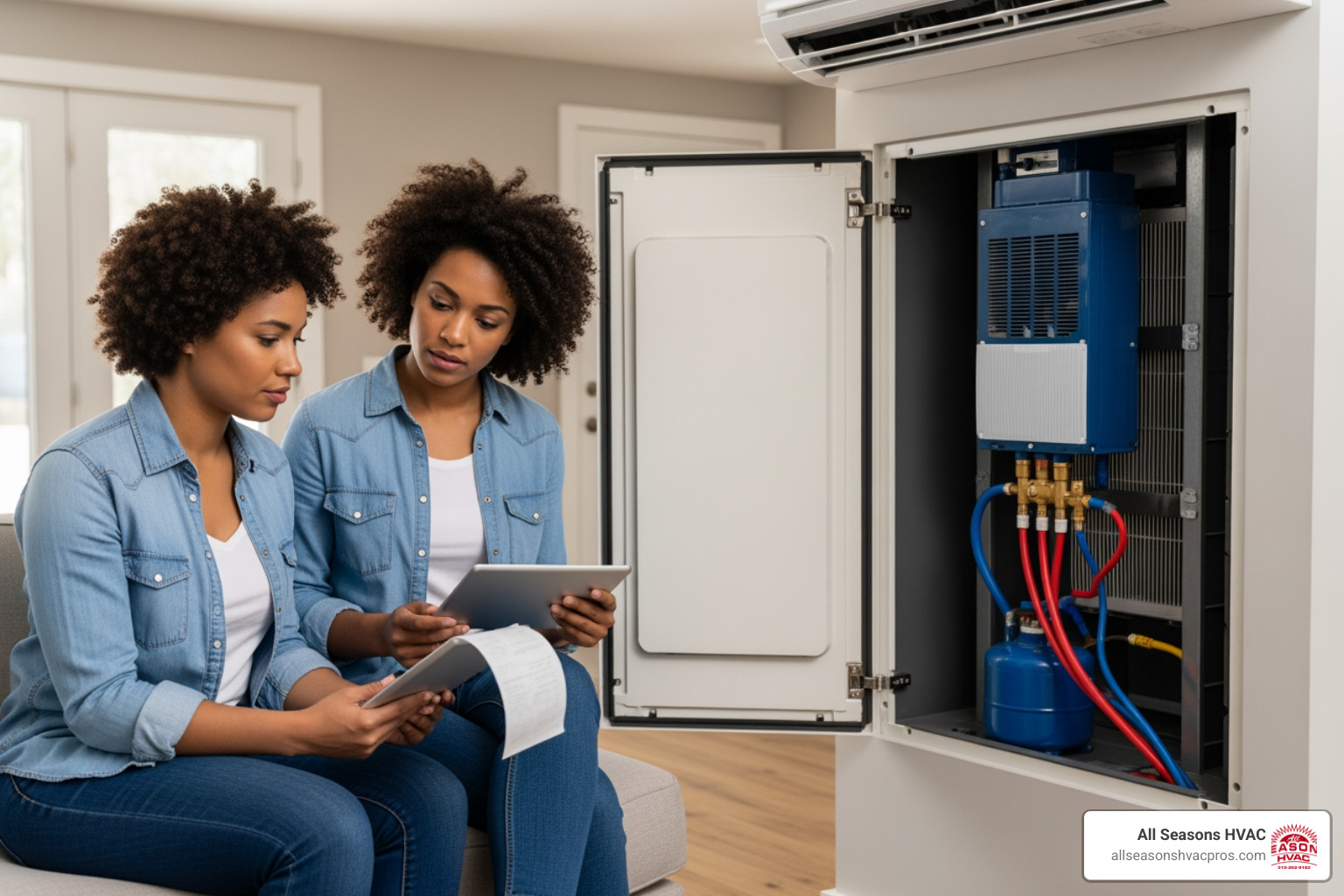

Why Heating and Cooling Bills Are Higher Than They Need to Be in Des Moines, IA
How ductless systems save energy with zone control is simpler than most homeowners expect: they stop conditioning rooms nobody is using, and they eliminate the hidden energy losses that traditional ductwork creates every single day.
Here’s the quick answer:
How Ductless Systems Save Energy with Zone Control
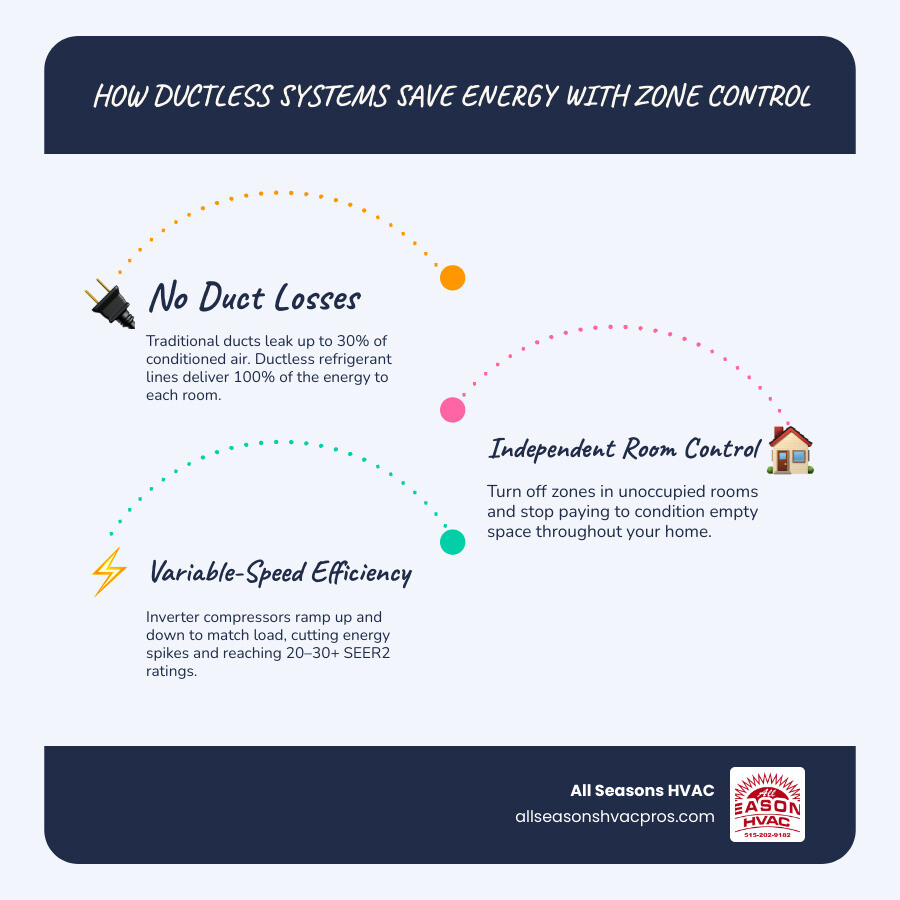
- No duct losses — Traditional ducts leak up to 30% of conditioned air before it ever reaches a room. Ductless systems use refrigerant lines instead, so none of that energy is wasted.
- Only heat or cool occupied rooms — Each indoor unit operates independently. Turn off zones nobody is using and stop paying to condition empty space.
- Variable-speed inverter compressors — Instead of blasting on at full power and shutting off, ductless compressors ramp up and down to match the exact load, cutting energy spikes.
- Higher efficiency ratings — Ductless mini-splits commonly reach 20–30+ SEER2, well above the 14–16 SEER2 typical of standard central AC systems.
- Result — Most homeowners who switch see 20–40% lower heating and cooling costs annually.
For budget-conscious homeowners in Des Moines and Central Iowa, that kind of ongoing savings matters. The average household spends roughly $1,900 per year on energy, with nearly half of that going straight to heating and cooling. A ductless zoned system attacks that number from two directions at once: tighter delivery and smarter targeting.
The rest of this guide walks through exactly how it works, which setup is right for your home, and how to keep the system running at peak efficiency year after year.
What is a Ductless Mini-Split and How Does It Differ From Central HVAC?
To understand how these systems slash your utility bills, we first need to look at how they are built. A traditional central HVAC system is a “one-size-fits-all” solution. It relies on a single, large indoor furnace or air handler connected to a web of sheet metal or flexible ducts. This central unit blasts conditioned air through your walls, floors, or ceiling to every room at once, regardless of whether anyone is actually in those rooms.
A ductless mini-split system, on the other hand, bypasses the ductwork entirely. The system is split into two primary physical components:
- An outdoor condenser/heat pump — This unit sits quietly outside your home, pumping refrigerant and regulating thermal energy.
- One or more indoor air handlers — These sleek, compact units are mounted directly on the walls, ceilings, or floors of the specific rooms you want to heat or cool.
Instead of bulky, dusty metal ducts, the indoor and outdoor components are connected by a slim conduit. This conduit houses a power cable, communication lines, condensate drain, and copper refrigerant lines. It only requires a small, three-inch hole through an exterior wall to link the units together.
Because they distribute thermal energy via liquid refrigerant rather than pushing forced air through long branches of ductwork, ductless systems offer an entirely different approach to home comfort. For many local properties, this setup serves as a highly efficient alternative. You can read more about how this applies to local homes in our article, Ductless Heating and Cooling: A Des Moines Homeowner’s Secret Weapon.
Here is a direct comparison of how these two configurations stack up:
| Feature | Ductless Mini-Split Systems | Traditional Ducted Central HVAC |
|---|---|---|
| Air Distribution | Direct room-by-room delivery via individual air handlers | Central blower pushing air through a network of ducts |
| Energy Loss | Virtually 0% (no ductwork to leak or lose heat) | Up to 30% or more due to duct leaks and conduction |
| Zoning Capability | Built-in; independent temperature controls for each room | Very difficult; requires complex mechanical dampers |
| Compressor Technology | Variable-speed inverter (modulates up and down) | Single-stage or two-stage (runs mostly at 100% capacity) |
| Efficiency Ratings | Commonly 20 to 30+ SEER2 | Typically 14 to 18 SEER2 |
| Installation Impact | Minimal; requires only a small 3-inch hole in the wall | Invasive; requires cutting drywall and running bulky ducts |
How Ductless Systems Save Energy with Zone Control

Now let’s dive into the core mechanism of these systems: zone control.
With a traditional central thermostat, your HVAC system has a blind spot. If your thermostat is in the hallway, it only knows the temperature in that specific hallway. It will keep running until that spot hits 72°F, even if your upstairs bedrooms are sweltering or your unused basement is freezing. You are forced to pay to heat or cool your entire house just to make one room comfortable.
Ductless zone control solves this problem by dividing your home into distinct, independently controlled comfort zones. Each indoor air handler has its own built-in thermostat, fan speed controls, and wireless remote. This means you can customize the temperature in each room based on how you actually use your home:
- Condition only occupied spaces: If you spend your day working in your home office, you can set that specific wall unit to a comfortable temperature while turning down the units in the bedrooms and living room.
- Match individual preferences: If one family member prefers a cool 68°F bedroom while another wants their space at 73°F, both can have their way without starting a thermostat war.
- Shut off unused rooms: Guest rooms, formal dining areas, and bonus spaces can be shut off entirely when empty, saving you hundreds of dollars a year in wasted runtime.
By targeting your heating and cooling only where and when it is needed, you stop paying to condition empty air. To explore tailored solutions for your home, you can learn more about our local services on our HVAC Des Moines IA Mini Split Air Conditioner Services page.
Eliminating the “Duct Tax” and Distribution Losses
Beyond targeted heating and cooling, ductless systems save energy by completely eliminating what industry professionals call the “duct tax.”
In a standard ducted central system, air has to travel through a maze of metal or plastic tubes to reach your living spaces. According to the U.S. Department of Energy, the typical home loses more than 30% of its heating and cooling energy through air ducts. This waste happens in two ways:
- Physical leaks: Over time, duct seams split, joints loosen, and flexible ductwork gets crushed or chewed by pests. This allows expensive, conditioned air to escape into your unconditioned attic, crawlspace, or wall cavities.
- Conduction: Heat naturally moves toward cold. When you run cool air through uninsulated metal ducts running across a 140°F attic in the middle of an Iowa summer, the air warms up significantly before it ever exits the register. Your air conditioner has to work twice as hard to make up for that thermal transfer.
Because ductless systems carry refrigerant directly to the room air handler, there are no ducts to leak, pinch, or absorb outdoor heat. Every single BTU of cooling or heating your system generates is delivered straight into your living space.
How Ductless Systems Save Energy with Zone Control and Variable-Speed Inverters
The magic behind the efficiency of a ductless system lies under the hood of the outdoor unit. Traditional central air conditioners use single-stage compressors. Think of a single-stage compressor like a light switch: it is either 100% on or completely off.
When your home warms up slightly, a traditional AC kicks on at full blast, consumes a massive spike of electricity to start up, runs until the room cools down, and then shuts off. This constant “short-cycling” is incredibly inefficient—similar to driving in stop-and-go city traffic.
Ductless systems utilize inverter-driven, variable-speed compressors. Instead of an on/off switch, an inverter compressor acts like a dimmer switch. It can modulate its speed anywhere from 10% to 100% capacity in real-time.
When you first turn the system on, it ramps up to bring the room to your desired temperature. Once that temperature is reached, the inverter ramps down to a low, whisper-quiet cruise control, using just enough energy to maintain that temperature.
This continuous, low-speed operation has major benefits:
- No starting energy spikes: The system avoids the heavy electrical draws associated with turning on and off.
- Incredible efficiency ratings: Because they modulate their output, ductless systems regularly achieve ratings of 20 to 30+ SEER2 (Seasonal Energy Efficiency Ratio) for cooling and 10 to 12+ HSPF2 (Heating Seasonal Performance Factor) for heating.
- Better dehumidification: By running continuously at lower speeds, the indoor coils remain cold longer, pulling more moisture out of your humid summer air without over-cooling your rooms.
Single-Zone vs. Multi-Zone Systems: Choosing the Right Setup
When planning a ductless upgrade, you will choose between two main configurations: single-zone and multi-zone systems.
- Single-Zone Systems: One outdoor condenser is paired with exactly one indoor air handler. This is the most straightforward setup, designed to solve comfort issues in a single, specific space.
- Multi-Zone Systems: One heavy-duty outdoor condenser is connected to multiple indoor air handlers (typically anywhere from two to five units). Each indoor unit is piped back to the same outdoor compressor, allowing you to establish independent zones throughout your entire home.
When to Choose a Single-Zone Mini-Split
Single-zone systems are the perfect problem-solvers for targeted comfort issues. They are highly effective for:
- Home additions: If you are building a sunroom, converting a garage, or finishing a basement, a single-zone system allows you to condition that space without overloading your existing central HVAC system.
- Stubborn rooms: Many homes have that one room—often a west-facing bedroom or a bonus room over the garage—that stays five degrees warmer than the rest of the house. A single-zone unit provides localized relief.
If you are looking to add targeted comfort to a specific room, we can help you find the right fit. Check out our localized options for HVAC Urbandale IA Mini Split Air Conditioner and HVAC Norwalk IA Mini Split Air Conditioner installations.
When to Choose a Multi-Zone System
Multi-zone systems are ideal for whole-home comfort, historic properties, or multi-story layouts where installing ductwork is physically impossible or financially impractical. They are best suited for:
- Multi-story homes: Heat naturally rises, making upstairs bedrooms sweltering while the main floor is chilly. Placing air handlers in bedrooms and living areas allows you to balance your home’s climate perfectly.
- Zoning flexibility: If you have a large home where entire wings or floors go unused during certain parts of the day, a multi-zone setup lets you shut down those areas to maximize your energy savings.
We design and install multi-zone systems tailored to your specific home layout across Central Iowa. Explore our neighborhood-specific pages to learn more:
- HVAC West Des Moines IA Mini Split Air Conditioner
- HVAC Waukee IA Mini Split Air Conditioner
- HVAC Ankeny IA Mini Split Air Conditioner
- HVAC Indianola IA Mini Split Air Conditioner
Sizing, Installation, and Maintenance for Peak Efficiency
While ductless systems are inherently efficient, they must be properly sized, positioned, and maintained to deliver their promised energy savings. Cutting corners during the design or installation phase can lead to short-cycling, high utility bills, and premature system failure.
For the best results, it is critical to work with trained professionals who understand the nuances of ductless technology. You can read our expert guide on Effective Mini Split Installation Tips and learn why it pays to hire specialized Technicians for Mini Split Installation.
Sizing and Placement Best Practices
Sizing a mini-split is not as simple as matching square footage to a chart. An experienced technician must perform a detailed Manual J Load Calculation. This calculation takes into account:
- Local climate extremes (such as our freezing Iowa winters and humid summers).
- The insulation levels in your walls and attic.
- The size, type, and orientation of your windows (west-facing glass absorbs significantly more solar heat).
- Typical room occupancy and heat-generating appliances (like kitchens).
If a system is undersized, it will run constantly at 100% capacity, failing to keep you comfortable while driving up your electric bills. If it is oversized, it will cool the room too quickly and shut off before it has a chance to dehumidify the air, leaving you with a cold, clammy, and uncomfortable space.
Physical placement of the indoor units is also vital. Wall-mounted air handlers should be placed high on the wall where they can distribute air evenly across the room without obstruction from furniture or curtains.
Our local installation services are tailored to the unique architectural styles of Central Iowa homes. Find your local installation page below:
- HVAC Des Moines IA Mini Split Installation
- HVAC Ankeny IA Mini Split Installation
- HVAC Waukee IA Mini Split Installation
- HVAC West Des Moines IA Mini Split Installation
Essential Maintenance to Protect Your Energy Savings
Once your system is installed, basic upkeep is required to keep it running at peak efficiency. Because ductless units draw air directly from the room, their filters can get dirty faster than central systems.
Here is your essential maintenance checklist:
- Clean the mesh filters every 2 to 4 weeks: Most mini-split units have washable plastic mesh filters located right behind the front panel. Simply pop the panel open, slide the filters out, rinse them in the sink, let them dry completely, and slide them back in. Dirty filters restrict airflow, forcing the fan motor to work harder and reducing efficiency.
- Keep the outdoor unit clear: Ensure grass clippings, leaves, snow, and weeds are kept at least two feet away from the outdoor condenser to maintain proper airflow.
- Schedule professional deep cleanings: Every 1 to 3 years, have a professional deep-clean your indoor units. Over time, dust and moisture can accumulate on the blowers and evaporator coils, which can lead to mold growth and reduced heat transfer.
For professional maintenance and local support, you can reach out to our team in your area:
- HVAC Urbandale IA Mini Split Installation
- HVAC Norwalk IA Mini Split Installation
- HVAC Indianola IA Mini Split Installation
Frequently Asked Questions
How do ductless systems save energy with zone control compared to central AC?
Ductless systems save energy by avoiding the 30% distribution loss common in traditional ductwork. Additionally, because each indoor unit is controlled independently, you only pay to heat or cool the rooms you are actively using, rather than conditioning your entire home all day.
Can I heat one room while cooling another with a multi-zone system?
In a standard residential multi-zone setup, the outdoor compressor can only operate in one mode at a time (either heating or cooling). All active indoor units must be set to the same mode, though you can adjust each room to a different temperature or turn individual units off completely.
What maintenance is required to keep a ductless system running efficiently?
Homeowners should wash the indoor unit mesh filters every 2 to 4 weeks. Additionally, you should schedule a professional inspection and coil cleaning at least once a year to keep the system operating at peak performance and extend its lifespan.
Conclusion
If you are tired of high utility bills and uneven temperatures in your home, upgrading to a ductless mini-split system is one of the smartest investments you can make. By putting you in complete control of your comfort room-by-room, these systems eliminate wasted energy, bypass leaky ductwork, and leverage advanced inverter technology to keep your home comfortable year-round.
At All Seasons HVAC LLC, we are proud to help homeowners across the Greater Des Moines area find budget-friendly, high-efficiency comfort solutions. With our flexible financing plans, upgrading your home’s comfort is more accessible than ever.
Ready to see how much you can save? Schedule your professional ductless consultation with All Seasons HVAC LLC today and let our experienced team help you design the perfect zoned comfort system for your home.